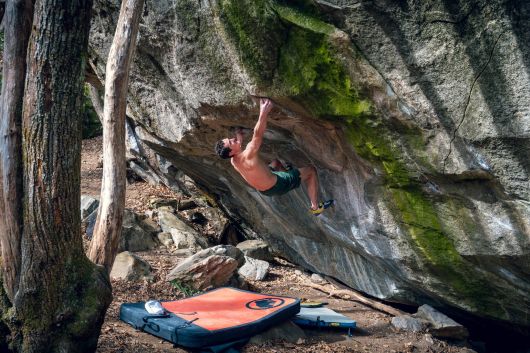
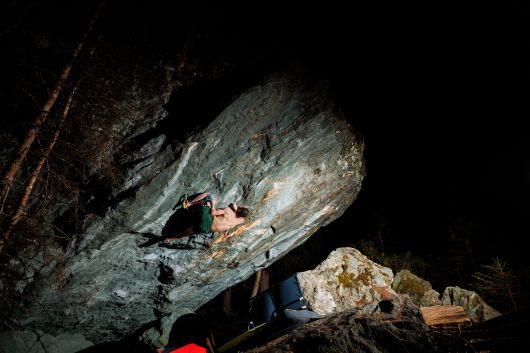
Emotional Landscapes 8C Hard / V15 Flash
Created by: Adam Ondra2026/03/16
As I was thinking about my goals in winter, there was always one boulder that I was extremely impressed by. Bügeleisen is one of the best boulderproblems I have ever seen. It was first ascended by Klem Loskot back in 2001 from a standstart as 8B+, while Nalle Hukkaitaval added an obvious sitstart at 8C in 2014. While I had always been so impressed and motivated to try this boulder, I had never really thought it could be possible for me to go for the flash of this boulder from sitstart. The problem is very much a board-style problem, with pretty straightforward pulling on tiny incut crimps. Board-style problems had never been my strength. Yet, as I was training this winter in Arco with my friends on boards, I could really notice that there are some aspects of board climbing that fit my style better than others. I am not very strong when it comes to jumping and latching on board-style problems, but the best possible way to climb Bügeleisen is to never cut loose, always have your feet on the wall and climb in a controlled way. And that is the style of board climbing where I feel pretty good right now.
So I reconsidered my goal, and after successful ascents in Ticino, I thought that the ultimate flash of this season could be Bügeleisen sit 8C. I felt ready for it. I arrived alone, but I was lucky enough to meet Zan Sudar, who was also working on it. So I took a long time to touch all the holds, study all the videobeta and decide what could be my own beta. And it was very good to have Zan and see him trying the boulder for real.
Ethical inntermezzo
I was always thinking that for a proper flash try on a boulder, you are allowed to touch holds as high as you can reach, but you can't stack multiple pads or climb a ladder to touch the holds higher up. But this approach comes with some problems that some holds are reachable if you are tall, while some short climbers can't reach them. And is one pad OK to reach the holds? How thick a pad? And this approach would inevitably lead to only trying lowballs, where you can easily touch all the holds from the ground.
So my perception shifted as I also knew that the other 8C's flash was done with the help of a ladder or stacking pads to touch some of the holds. So I adopted this style too. For Deep Fake, Celestite or Lion's Share or Emotional Landscapes, it does not really change very much, as the majority of the holds can be easily reached from the ground. Bügeleisen or Unison are a different story, though, and in these problems it would make a huge difference if you adopted a no ladder approach. It might still make sense to go for the pure flash without touching any holds higher than stand-start holds if you want to keep your ethical standards extremely pure. But I decided to go for a ladder-flash ascent.
I set off for my flash try, flowing very well on the lower part of the problem, everything going absolutely perfect. Almost too perfect. 3 moves from the lip, there is a hard move going from tiny three-finger right hand sidepull into decent incut left hand crimp. I tried really hard to control this move as much as possible, but in the very last moment, I had to jump and missed the in-cut part of the hold. I still didn't fall, but I needed to readjust, but I was not able to do it. I tried to continue, but fall was inevitable. It was frustrating to mess up my flash try on a boulder that had been my dream for such a long time. I looked at my fingertips, and I could see that the next try could easily result in splitting a tip. That is why I decided not to try again, and take advantage of the good flow at another boulder - Emotional Landscapes.


Emotional Landscapes
This is another of Klem Loskot's masterpieces and one of the very first 8C's in the world from 2002. It only received a handful of ascents during the years. Some ascents were done using the foothold far left for the first move, but that foothold broke. Nicolai Uznik still used this method and felt the boulder was more in the 8C+ range, and I think it could be correct. I don't really know which beta Klem was using, as there are two videos available on YouTube, where he is trying both betas. I saw Jakob Schubert and Mischa Piccolruaz working on the problem the week before, while I was trying Mount Doom 9A. Jakob and Mischa tried the boulder with the left method, and it was obvious to me that flashing the boulder with that method would not be possible for me. But the day after, they found the way with a heel-toe cam far right that Klem is using "Carinthian projects" video, and they both sent that day. Knowing this, I knew that there might be a small chance for that boulder to be flashed.

I walked over to Emotional Landscapes and made a video call with Jakob Schubert, who kindly explained everything to me. The biggest mystery was the second move, where everyone had a different beta. I decided to stick with Klem's beta, mostly because it involves a thumb-catch, and I love this kind of hold. I set off and almost fumbled on the first move, almost leaning backwards just before getting the good crimp. But I was in the game! From now on, my mind game was perfect. The second move was executed perfectly. I still didn't fall. Oh my god. And from now on, I knew the problem was much more my style. Crossing over and matching a very small crimp, and all the adrenaline rush and motivation made me crimp that thing as hard as I could. I don't think I have ever produced as much force with my fingers against a piece of rock. And I got the famous jump into the slot; I actually got it very precisely, and finishing the climb was just a bit unnerving but very much under control. My emotions were not really under control as I melted into a slab, knowing that I had just flashed Emotional Landscapes!
Photos in the gallery and in the article by Zan Lovenjak Sudar and Nikolaj Novak.